


 Apple Podcasts
 Spotify
 Youtube Music
  RSS Feed
 Linebreeding Chickens: Build Consistency Without Losing Vigor – Audio Edition
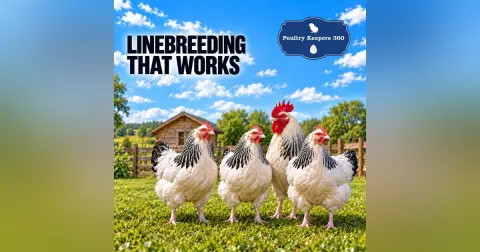
Linebreeding can reveal weaknesses already hiding in a flock—and that is exactly why careful breeders use it.
This Audio Edition was adapted from a PK360 LIVE conversation featuring Rip Stalvey, poultry nutritionist Jeff Mattocks, Karen Johnson, and guest Logan Courtney. Logan is a sixth-generation Oklahoma farmer who uses linebreeding with registered Jersey dairy cattle, Hereford cattle, and Light Sussex chickens.
Together, they discuss what linebreeding can accomplish, why it sometimes produces disappointing generations, and how selection, records, nutrition, and patience work together to build a more consistent flock.
Topics include:
• What linebreeding is and what it can accomplish
• Why it exposes hidden genetic problems
• Clan breeding and practical systems for smaller flocks
• Record keeping, wing bands, and pedigree software
• Protecting size, vigor, fertility, and production
• Choosing breeders and evaluating each generation
• Starting with limited breeding stock
• Bringing a needed improvement into an established line
• Giving birds the nutrition needed to express their genetic potential
Original PK360 LIVE video broadcast date: February8, 2024
Prefer the original video? Watch the PK360 LIVE Video Edition here:
https://youtube.com/live/96mZJxuCYog
If you enjoy thoughtful, experience-based poultry information like this, that’s what this channel is all about.
#PoultryBreeding #ChickenGenetics #PoultryKeepers360
Chapters and timestamps
0:00 Meet Logan Courtney
4:46 What Linebreeding Really Does
8:22 Consistency, Selection and Patience
14:09 Records, Wing Bands and Pedigrees
16:58 Building a Clan Breeding System
22:57 Protecting Production Qualities
27:15 A Practical Program for Smaller Flocks
31:24 Matings That Reveal Hidden Genetics
36:47 Exposing and Removing Genetic Problems
38:31 Maintaining Vigor and Choosing Breeders
43:11 Nutrition and Genetic Potential
47:26 Egg Selection and When to Cull
52:11 Can You Start With One Pair?
56:52 Introducing Improvements Into a Line
1:00:03 How Long Should You Use a Proven Male?
1:03:26 Closing Thoughts and Future Questions
Join our Facebook Groups:
Poultry Keepers 360 - - https://www.facebook.com/groups/354973752688125
Poultry Breeders Nutrition - https://www.facebook.com/groups/4908798409211973
Good evening, everyone. So happy you could join us for Folker Keepers 360 tonight. We have a really special guest, and uh I think you're gonna not only enjoy it, but I think you're gonna get an awful lot out of it. Um, because I have always been impressed with our guest's knowledge of work and understanding of life reading uh in his channel, but I know he's also doing that in his pocket box as well. So allow me to introduce tonight Logan Cortey from Oklahoma. Great state of Oklahoma. Logan, glad to have you with us tonight.
SPEAKER_02Hey, thanks for uh inviting me. I'm really excited to get to visit with you guys and always enjoy following um all the great content you put out. I always learn something every time, it seems like uh I really enjoy it. So thanks for having me.
SPEAKER_00Our pleasure. And folks, you can see that Jeff Maddox is here and Karen Johnson is here. Um Karen's kind of been struggling with some technical issues on her end, but hopefully we'll get that. She's got that whipped. So good to have all of us together tonight. It's gonna be a fun show. Fun show. Before we get started, does anybody have anything they want to bring up other than the subject of line breeding? It's always dangerous when we all get quiet at this point in the show. So, Logan. Yes, sir. Tell us a little bit about your history and introduction to line breeding. What you may not know, Logan is not only into poultry, but he's got their family, has had a long-term Hereford breeding operation out there as well. And he's also into uh Jersey dairy cattle. But tell us a little bit about what you do there.
SPEAKER_02Yeah, so I'm a sixth-generation farmer and on our current farm. We Courtney Farms was established in 1863, and it was originally established as a dairy farm where they were bottling milk, selling it, you know, with a wagon and horse or drum wagon and milk delivery route. And since then, a lot of things have changed, and agriculture has been a big part of my entire life and has been for generations. We we milk a herd of about 70 registered jerseys. We milk with a robotic system. We were the first robotic dairy in the state of Oklahoma and really proud to you know be bringing that innovation into the state. We really like you know keeping up with modern things, but we implement a lot of line breeding on the dairy using good old proven lines to create the ideal cow for what we're wanting to breed for. But we also do a large cow cattle operation cattle. We breed herfruits and have for a lot of years. Today we primarily are breeding her fruits to use for cross-breeding. So we have a very lime bred herd that are known as lime one herfruits. Um it's a breeding program that was started in Montana about nine decades ago. We utilize those lime bread genetics to use to get maximum heterosis to make the F1 balding. So we implement a lot of lime breeding in that for different reasons because we want that high rate heterosis, uniformity, those really good compound traits that we can get with a lime breeding program. So it's something I got to know just from working with it directly as part of our breeding programs. We also I do poultry for fun. It's probably one of my it's my hobby when I need a break from you know, real life and stuff. I think that's the case for a lot of us. And the poultry that we raise. Oh yeah, oh yeah. We do the light stustics, and for anyone that knows, that's a pretty rare breed of poultry, so it's we have to use line breeding to maintain what's left of that variety. Yeah, so it's something we use line breeding a lot and it works well for us, and I think it's something that a lot of people don't fully understand. And some tools are not used correctly, some tools are underused and overused, and uh so it's a great, you know, it's a great tool in the toolbox to use if it's done correctly.
SPEAKER_04So very good.
SPEAKER_00Thank you. Tell us how you would define line breeding. What what is that whole line breeding process?
SPEAKER_02So for me, and I looked up the definition so that I could look smart, and I got my sheet right here. So the def the definition of line breeding is to breed closely, we're closely related people or animals, especially over many generations. Of course, we're talking in the animal aspect here and not the Habsburg example. We can see two opposite ends of the spectrum of what we don't want and what we do want. So line breeding is an extremely useful tool, and this is my definition of it, to set uniform type. I'm mildly OCD, and so I want to, when I'm turning out, whether it's cattle or you know, geraniums or if it's you know poultry, I want uniformity across the board. And lime breeding creates the opportunity to get that uniformity. And poultry, as most people, you know, as as you guys know, most of your viewers will know, it's based on phenotype. And lime breeding creates the opportunity that we can focus and step that phenotype. Uh, if it's a pattern bird, it's a good trace we want in those birds, for example. So it's uh it's a very useful tool for setting the type, but it's also an excellent, excellent tool to identify defects in your lines. Uh, a lot of people will say, well, line breeding, you're gonna get two headed calves and three-legged chickens and you know that kind of stuff. And I always tell people, line breeding didn't do that. Those issues were already there. Line breeding exposed the faults in your line. And that's something I think a lot of people, you know, don't want to realize or you know, understand that you can only depend on that outcross so much to hide the problems in the line before it's becomes a big issue. And we see that in a lot of animals today, or in my opinion, that's the case. Line breeding is your old tried and true method to find those. In a lot of cattle, we have genetic tests we can do to find those problems and eliminate them. I'm not aware of any, and correct me if I'm wrong, we don't have that luxury in poultry to identify those major genetic defects, and line breeding is a good way to find them.
SPEAKER_00So I know that's something they're working on, identifying the genetic issues. I don't know how far they've gotten with it. I just recently saw a post yesterday or maybe the day before, over on the Americana group, where they've now been able to sequence the genes and identify those that are homozygous or heterozygous for blue egg shells. Sweet.
SPEAKER_02So and that's what's great. It's always it's always changing and always adapting, and uh always great to see them progressing.
SPEAKER_00And Logan, you bring up a point that I I really want to kind of drive home. And folks, he was talking about it's important to breed for uniformity in our birds. I see so many people that just breed birds. Well, they propagate birds. They put a rooster and hen together, and what comes out comes out, and there's no really planned program for getting that flock uniform. I know how I do it, but that doesn't mean what I do is the only way to do it. But it no matter what kind of line breeding you do with poultry, you better be ready to do some serious, consistent culling. Yep.
SPEAKER_02And that's where I think that's a common issue that most people have. And and it and it is hard to go through all your grow outs from the year and you tear down, oh, I've only got five or six worth keeping, and the rest I'm gonna take to the poultry auction. You know, it's it's hard, you know, and but it's once you do it, it's amazing in just a few years how much you can improve, and it's really worth it, in my opinion, at least.
SPEAKER_06Yeah, don't I mean, Logan, I mean, uh from what I've heard and what I've seen, that first line breeding isn't necessarily a train wreck, right? Like you don't you may not have to call down 80% or more. It's usually the second, third, and fourth when you really start popping all those imperfections. And a lot of people get cold feet, scared, and quit right there. They think they've made a serious wrong turn, like they're already seeing that inbreeding, you know, train wreck for lack of better terms. They just need to push through it, you know, because I I don't know what you're seeing, but I think when you get out there to like seven, seven or eight years, or seven or eight year matings, things start to straighten out again, and you come back to that, you come back to that 80% consistency, and your call rate is only 20 or 30 percent. Is that kind of what you're seeing as well?
SPEAKER_02I would agree with that wholeheartedly, and you know, it's something if you it gets worse before it gets better in some cases, and you just gotta power through it.
SPEAKER_00Jeff, I think you're absolutely right. So many people hit that point when things start to go bad, and so they immediately hit the panic button and start bringing in new new blood and all that, and that just really compounds it.
SPEAKER_06You just reset the clock on your breeding program.
SPEAKER_00Oh, yeah.
SPEAKER_06So, you know, if you if you don't have the persistency to look at ugly birds and be able to call them out, then line breeding isn't for you. Okay, so just keep doing what you're doing. But if you want to purify a line like Logan's doing, you know, it's a necessity to get those defects out.
SPEAKER_00And Logan, correct me if I'm wrong, but I can't think of a single strain of livestock, chickens or cattle or horses or swine, whatever, that didn't get to be a really good strain of livestock if it weren't for line breeding.
SPEAKER_02I I agree wholeheartedly with that. Um most of my I love history and the history of pedigrees, and that's something I really enjoy. Um, whenever you look at those pedigrees, it is incredible how much line breeding was used. And and we know even looking back at the great old poultry books, you know, that's that's a mainstay. Endless outcrosses are kind of a I would say a modern thing. You know, and it's just I think people just don't understand them. We're naturally scared of what we don't understand.
SPEAKER_04I agree with you.
SPEAKER_00You were talking about pedigrees. Now, I know that's something we don't have in poultry, at least official pedigrees. Formal formal pedigrees, you can start doing those on your own. Because it is important to know where your birds came from, what's behind the birds you have, because that can give you a pretty good clue sometimes where your birds are going as you as you move forward.
SPEAKER_02Well, I always like to compare it to making a cake. If I start with a vanilla cake mix, no matter how long I stir it or how long I bake it, it's not going to turn into a chocolate cake if I don't have the right ingredients to start with. And so if you don't know where you're coming from, yeah, you may luck out, you may not, you know, you're you're up to a lot of gambles. And I don't like gambles. I want to know where we're going. A lime breeding program or any breeding program for that matter is only as good as your foundation. And if you don't know what that foundation is, then kind of like before the show, y'all were talking about where certain lines originated, and that's so many people you ask, well, where does this line come from?
SPEAKER_01Well, I don't know.
SPEAKER_02Well, and you're just like, Well, you don't know anything, you're breeding blind, and that's that scares me. I I mean, just this afternoon I was working on a dairy cow pedigree that I was just curious what when she was imported, and we went back 150 years in her pedigree. And while maybe that doesn't affect the modern day cow, it's still it's still amazing to see what all those generations were for the past century and a half behind her. Because it really creates what it what she is today, and it's the same in poultry, and we just don't generally have those records, and that's a real shame.
SPEAKER_00And and folks, uh one thing that has always impressed me about Logan is his mastery, and and it's a little scary to be honest with you, to me how well he can just recall just boom, boom, boom, pedigrees for his cattle.
SPEAKER_02And now don't ask me to remember someone's name though.
SPEAKER_00Oh well, hey, been there, done that, buddy. But you know, I I can't even begin to fathom, Logan, how much practice and skill and dedication it takes to be able to do that. You don't find, and we were talking about this before we went on the air, you don't find too many people out there that can do that.
SPEAKER_02Well, and it's something I use a pedigree software, it's actually for dogs, and I keep my chicken records in there, I keep my dairy cow records, I don't keep the Hertford records in there, but it lays it out in a 10-generation setting. And I'm still working on filling in certain lines of poultry just because I've not worked with that line long enough to have the records of who who who is who's who and who's what. But you know, it's something you build. And a lot of us, you know, even if you just have a trio of chickens at home, you you can keep records on them. You know, it there's no program that's too small. Yeah, a lot of it's in our head, but if we can keep those records, you're better off down the road. Breeding anything is a long-term commitment. You know, I think a lot of people, you know, chickens hatch so fast, generations move so fast. I can keep it all in my head, but it's it's very beneficial. And I I know that's not telling you know a lot of people anything new, but it's something really, really interesting.
SPEAKER_05All right. Before you go any further, I know 17 people want to know, okay, what what program is that? Yeah.
SPEAKER_02I meant to look it up what the name of it is. It's Breeder Assistant. It comes out of the UK. You do have to buy it. Uh it's Breeders Assist or Breeders Assistant. Um, if you Google it, it'll pull it up. It comes out of the UK, you have to pay an initial subscription for it. But you can record anything, even down if you want to keep records. If you're an exhibition person, you can put this bird was champion English, a blah blah blah show, whatever. You know, you can even do that detail this stuff. So it's there's a there's a lot of great programs out there. Just generally look for dog pedigree software. Yeah, it's dog related, but you can you can definitely use it for if you're breeding goldfish, you can keep records.
SPEAKER_00Yeah, just swap out the term dog for chicken, you have it made.
SPEAKER_02Exactly. All right, but let's just go ahead, sorry.
SPEAKER_00No, no, no, you're on a roll.
SPEAKER_02Well, and then also kind of on the pedigree note, I'm not terribly good at math. That you know, I don't like doing math in my head. And when you're figuring things like inbreeding coefficients, if you have a pedigree software that will tell that information, it's a lot easier a click, and you're like, oh, I can see what the inbreeding coefficient of that bird is, if that's something that you're watching in your program. So that's good to know.
SPEAKER_00Logan, if you were going to describe an ideal line breeding system for poultry to someone, what would it look like?
SPEAKER_02So, like I said, breeding animals is like a toolbox. My favorite system may not be what works best for a different flock. I personally like a clan breeding system. And I think most poultry people I do talk to do some variation of that. Like we mentioned earlier, how do you manage things like size depression, which in poultry is a very real issue, especially in our large fowl? If we get too closely bred, we'll start shrinking down in size. And for a lot of large fowl, we we don't want to do that. You know, we're already struggling to do the size that we need, and you know, in a lot of cases, and I'm broadly speaking, that kind of deal. So, what clan breeding is for anybody that doesn't know, and I apologize if I'm kind of you know repeating stuff that someone does know. Clan breeding requires at least three tens or flocks or sets of birds. And sorry. So you're gonna want related females, and that's the way that I do my clan breeding system. When I started out with my Light Sussex project, I was lucky enough to be able to source, I actually sourced four original lines that were all loosely related to each other. So you have that lukewarm blood. I identify my lines with various colors of wing bands. So I know that the green wing bands are from my line one, you know, red from line two, so forth and so on. With those three initial lines, I would the way I do it is you're gonna take a male from line one, put them on the line two flock, so forth and so on. Resulting chicks carry the line number of their mother, or from whatever female pin, if you don't do one-on-one breedings, and so forth and so on. And you rotate, and basically every three generations you're taking that blood back onto the first one. And I hope that made any sense at all. It's something my mind goes faster than I thought. But you look up clan breeding to do more research, you know, it's something something really beneficial.
SPEAKER_00That's pretty much the way I was taught by my mentor in Rhode Island Reds to breed. I'm so glad I discovered Mr. Reese because he taught me so much about not just Rhode Island Reds but breeding poultry in in general. But he told me to start out with six full sisters, divide those into uh three pairs, and then use a male that's unrelated to any of those to hit up each pen. Yeah. And the females from that pen, like pin one, they would always go back into pen one. You wouldn't cross between those families. And that that has proven very, very beneficial to me doing it that way. I mean, it's simple enough I can keep it straight in my own mind.
SPEAKER_02So well, and that's why I like to do the colored wing bands. Yeah, they each still have a number, but when you're sorting birds and you've got a flashlight that you're holding in your mouth trying to sort tens of birds, and and maybe I'm the only person in the world that's I just started to say you've seen me sorting birds before, haven't you? Well, I was sorting some birds last night in the dark, and I had a flashlight in my mouth, and I'm like trying to see colors, and I'm like, oh, I I gotta do this better. But you know, if you do something like a colored wing band, you can sort a lot faster and still keep a number of who she is or or the who he is. But yeah, that's that's how I like to do it, and which it I think you've bred birds longer than I have. Has that helped manage your size depression or um those sorts of issues?
SPEAKER_00Yes. That's that's one thing I can say. I won't I shouldn't say I haven't had any problems with size because I have not getting too small but getting too large. That's that was the struggle for me for a while to get to get to size.
SPEAKER_02I'd rather have that struggle than thanks. Yes. Oh, I agree with you.
SPEAKER_00I agree with you. But it it was a bit of a challenge.
SPEAKER_06Yeah. I don't know, Rip. Don't I I mean to me, I would think coming up in size is way easier than going back down. You know, just just working with Karen, I know she was fighting to get her size back down to standard, and it was a real struggle. I I might be wrong, but from just what I've been seeing, it it appears that coming up in size has always been a little bit easier, you know, generationally. But Aaron, you would know more. You've been doing it.
SPEAKER_05Well, part of the issue is that in general, both exhibition and meet people want their birds bigger, like even if it's above standard, they're just more impressive. So part of it is the desire to stay smaller.
SPEAKER_00Jeff, that's especially true, I think, with banners, because it took me seven years to get the size of the banners down where I wanted it to be. It was not an easy, easy task, but I was able to hold out with what two brain cells I had left by the end of the project, but it can't it worked.
SPEAKER_06I just knew that Karen struggled with getting, you know, getting her trying to get her size back down to standard. And that seemed like it was a really long project. Uh I don't know. Maybe coming up is just as difficult, you know. But I don't know.
SPEAKER_00And I'm gonna get on my soapbox here for just a minute and run down this rabbit hole. But one thing we're not focusing on enough, I think, as breeders, is we're not focusing on the production traits of our birds. I I know there's some out there that are working with some breeds, and they're really putting a lot of effort into that. But it's something you've got to put effort into. It's something you you need to focus on. And a lot of people don't even realize, but in the standard of perfection, there's there's a whole section in there. Well, it's not very big, but it's probably like three or four paragraphs. But it's basically telling the breeders, the exhibitors, and the judges that you have to put proper focus on the production abilities of our birds. And that's what got us into trouble with a lot of birds. My Rhode Island Reds still don't lay anything like I would like for them to. And it it's it's a struggle to get that back up.
SPEAKER_02But well, and I ran into the same issue before I started my Life Sussex, which is what I truly enjoy now. I started with a different breed from a good line. You know, the birds showed very well and stuff, and I really liked the birds, but they had been neglected in the practical side of production. I am not exaggerating. If we got six and seven eggs a year out of a female, we were doing really good. Yep. I can believe it. You know, it was it was ridiculous. They were beautiful, you know. We we had fun showing them, but you didn't, you know, what's the point? You know, yeah.
SPEAKER_06How do you even do one? How do you even get decent progeny if you're only getting six or seven eggs? And you know, even if you assumed the best hatchability at 80%, right? You don't have anything to call. You just you can't afford to call from that small of a selection group.
SPEAKER_02So Jeff, I'm a reason I only have one of those left. I paid too much for her, and so we can't bear to see her go, you know. So she'll die here, but you know, she's a freeloader.
SPEAKER_00Well, nothing wrong with an occasional freeloader. But what were you gonna say, Rip? I forgot. Okay. It'll come to me in about 15 minutes or so. But uh, yeah, folks, please do focus on the production qualities of your birds. I think there's a time coming in the not so distant future where there's gonna be a real demand for heritage birds that not only look right, but they produce right. Not only just eggs, but in meat too. Uh, you know, so many birds in the American class are really good, or at least used to be really good dual-purpose birds, but not anymore. And that's a shame.
SPEAKER_06Well, and so you're right. Sadly, you're not gonna get those by going to a show, no, right? Because those have been bred to look really good. And you're not gonna get it from a hatchery, Rhode Island Red, for instance, because they've been they've been really bred down to make people happy to have backyard chickens, you know, lawn ornaments. So finding that breeder in between who's breeding for performance, you know, to what the bird's supposed to be, those are few and far between.
SPEAKER_02Well, and that's for anybody that's never handled like a really good rock, which I just recently a few weeks ago, I was at someone's block that had really, really good production bred for a rock. And when you hold a bird like that that has been carefully, carefully bred for productions rates, it's it's incredible. It was, you know, I I don't want to exaggerate and say life-changing, but it was it was very inspiring.
SPEAKER_00Um it's eye-opening.
SPEAKER_02Exactly.
SPEAKER_00And you're talking about rocks. Frank Reese's birds are an example of that.
SPEAKER_02Well, I think the birds, the bird went back to him, so yeah. So we know we know.
SPEAKER_00That would explain that. We talked a little bit about an ideal program, Logan. What about a practical line breeding program? What advice would you have for folks say, okay, this sounds pretty good. I want to try it, but what's practical for folks just getting started in that?
SPEAKER_02So, and this is just my opinion, not saying anyone's right or wrong on what they do at home. Um, and I'm sure somebody will disagree with this. My thing about being practical also is a practical space consideration, and I think anybody that has chickens, we never have enough hins. Um, find you your niche of breeders that you can swap birds with, and you can do a lime breeding program among two or three flocks. In our Light Sussex, for example, we're working with two other flocks, and our birds will swap about second and third cousin birds to bring in, you know, for lime breeding because you can only have so many tins of birds before they eat you at a house at home. Um and that's what that's the way I would consider the most practical lime breeding program. And and I'm sure there's other excellent examples of what you know what people should do. But I think that having your niche of people with like similar bred birds is one of the best the best ways to do it, in my opinion. And it also, if that's the line of birds you've worked on and you have something go through your birds, and you know, you lose your whole flock for some reason, you can regenerate your you know the same line without starting from scratch, too. So from a practical standpoint, that's what I would say.
SPEAKER_00Okay. Another question for you. You know, you already said that you're using a pedigree software program to track your birds. Somebody doesn't have access to that or can't afford to jump off into that right now. What can they do? How can they keep those birds straight?
SPEAKER_02I would bottom line, wing band, wing band everything. I don't like leg bands for a number of reasons, but wing bands is something I really like. And it's your little notepad. You can keep records, keep track of you know, your various lines. It's not hard. Um pedigree software is really fun. It's fun to keep out on, and but it's it's absolutely not necessary. If you have access to an Excel spreadsheet, you know, keep your records on that. It's it's all about you know knowing knowing where your birds are from and where they're from, you know, that's that's essential in my opinion. But you don't need it, you don't need a fancy software system to do it.
SPEAKER_00You know, Logan, you were talking about spreadsheets. If folks are members of Poultry Keepers 360 in our Facebook group, if they'll go into the file section, we have some uh spreadsheets there that Karen put together. She spent a good deal of time putting those together, and they they can certainly get you started if if nothing else, because they're not complex or hard to use. But if you're interested, go in there and check those out.
SPEAKER_02Oh yeah. And there's so many amazing resources, not just record keeping in in that Facebook group. I mean, I'll sit there of an evening and scroll through and find stuff. They're like, oh, well, that makes sense.
SPEAKER_00That's something I should have probably thought of of my own, but you know, you know, I only got about three brain stuff left, so you know well, it makes me happy to hear you say that about our group because that was exactly the reason I created that group originally was to share knowledge, to share information, and to help our fellow poultry breeders. That's that's something I don't see happening nearly as much as it used to, but it's getting better. What now I'm thinking here just a minute. Are there any particular tips and tricks from a practical standpoint that you have learned over the years about line breeding? What should what should people try first off?
SPEAKER_02So what I would really stress is aside from the record keeping of knowing what you're breeding to what, don't just keep it in your head because chickens change a lot and change fast, of course. You're gonna want to understand what kind of matings you're doing. I like doing matings of cousins, I keep your inbreeding coefficient at a reasonable level. Everyone has different opinions on that, especially in a lot of the cattle groups that I you know move in. But at the end of the day, my biggest tip to test the and and correct me if you know if there's other views on this, of course. Use those fire daughter matings. It's really going to tell you where you're at in that program. Some of our best exhibition birds right now are fire daughter matings, or the result of sire daughter matings, I should say. So that's that's the biggest tip, you know, when you're working with the line, where are we at in this? I do that across the back, and it really helps you check. That's something that I bring from uh more the cattle side. A lot of the old breeders traditionally, you know, they would not say how good a bull was until they used him across all of his daughters, and it really shows where where the genetics are. So that's a that's a tip. Other than the record keeping, you know, that's a big one.
SPEAKER_06So Logan, you don't see the same going back like son to mother. I tend to not okay. Does it I was gonna it doesn't work both both ways?
SPEAKER_02I I don't tend to do it a whole lot at the son to mother, but I know I know people that do, and I think it works, but I know that's a a debatable, you know, a debatable thing in some groups.
SPEAKER_06So I guess you need to see what your offspring are. You need to evaluate your offspring anyway, but listening to other geneticists, you know, it it appears as though the hen carries about 80% of the genetic profile. So I'm just wondering, you know, do you even do you do both, you know, sire to daughter and son?
SPEAKER_02And it does work, it does work.
SPEAKER_06It's just uh that may be a way of figuring out who's actually carrying the the genes you want. Is it the mother or is that sire dominant enough to you know to make a big inflection? So I don't know. I'm just asking what you know you're yeah, no, I you're you're not wrong.
SPEAKER_02I don't tend to do that a lot in my program just simply because I don't do one-on-one matings. I don't always know who the mother is of males, I just know what line they're from. And so that's why I tend to shy away from it. But if you do one-on-one matings or you know, have a really good sense, it would, I see where it would work.
SPEAKER_06I think a bunch of the people that are listening, you know, will do single mating specifically, you know, if they're seeing the the gene traits that they're you know, certain gene traits coming out, you know, they may do some single mating for the purpose, you know, of pushing that forward or trying to push that forward. So yeah, I didn't think about that. You said you were clan mating, so it's it's difficult to do the sun mode.
SPEAKER_02A little bit, yeah. Yeah, I have done some one-on-one mating in December. We were doing our first time ever doing one-on-one matings with the birds, but you know, I have eight to twelve females per group, so it's kind of it should all be, you know, very similar, but you don't know who laid the egg.
SPEAKER_06So just for the listeners, I mean, what what do you estimate your flock size to be? I know a chicken person never actually divulges the true number because they don't know, but you know.
SPEAKER_02I only have 10 fingers and 10 toes, and I can't count any tire. No, there's no we run about 45 breeding birds right now. So we we had some weather accidents last year that kind of cut back our flock size and in the license you know 4550 range. So that's kind of where we're at.
SPEAKER_05Can I this is not this is maybe more for for rip, but for everybody that's terrified of line breeding, what is the worst possible thing that can happen if you breed two birds together that you should not have done?
SPEAKER_00Uh you learn from that, and if they turned out really, really bad, hey, you get rid of the really, really bad birds, and B, you don't repeat that mating.
SPEAKER_06Well, I think she's at I mean, my curiosity, or what I heard her ask, is what is the worst thing you would see from that mating? I mean, what what's the worst possible outcome? You know, when you start getting too tight or you really screwed it up, what how ugly can it be?
SPEAKER_00Oh gosh. I I think a lot of it depends on the genetics that are in those two birds that you're mating together. Because, and honestly, that's the only way you're gonna find out what those birds are hiding genetically, is to do those kind of matings. Because it you stand a good chance of it really working and say, Hey, I want to do this again, or you stand a chance that that was not my best idea. Shaggy.
SPEAKER_06Shaggy says they don't have that's the worst that that's the worst possible outcome.
SPEAKER_05So and that's and that's sort of what I'm getting at. Like, I'm thinking everybody's afraid they're gonna end up with these mutants, you know what I mean? Like, I mean, and that's not really you just end up with birds that are not as good as the parents, like you can end up with some cross beaks or some, you know, but you know, that's what we're calling for in the first place, you know.
SPEAKER_00Right.
SPEAKER_05So I I know not as scary as people are thinking.
SPEAKER_02Go ahead, and that's really important to remember line breeding is not creating that, those genetics are already there. And so, do you want to live in bliss and just keep them hidden in your line, or do you want to express them, identify them, and remove them from your breeding population? Or that's the way I look at it.
SPEAKER_06Yeah, because otherwise they're they're gonna be there, you know, continually, and and you're only gonna get a small portion where it pops out, you know, over the years, and that's easy to call that 10 or 15 percent or whatever it is. But if you like you said, if you want to clean out those those defects that are hiding, line breeding is the way to do it.
SPEAKER_00So I think one thing that my mentor really impressed upon me is in really in any breeding program, you really need to keep an eye on the vigor of your birds because once you start losing the vigor, it's really, really hard to get it back. Logan, I a question just occurred to me that I get asked a lot, and and you may too, I don't know. But how long or how many years should a breeder use a particular bird in their breeding program? What's your thoughts?
SPEAKER_02Ideally, and and this is just my opinion, I like to change my males out every you know, two years approximately, because you know, you can make your advancements genetically, you know, using your younger birds. Um if you have the numbers, it probably wouldn't be a bad thing to, you know, once only keep your you know, hands one year as you know, they're layers, yeah. Sorry, only keep one year of hand production out of them so you get those nice big eggs and then move them on. I breed from older hands just because we're working with such a small population, but your younger birds should be your genetically superior birds, in my opinion, to carry on forward. So, you know, two, three years, and you probably should be turning them over, which in most cases the birds are ready to turn over by then anyway. You know, okay. I've been telling you, there's no harm in using older birds either, but yeah.
SPEAKER_00I've I've had some breeders at shows will tell me I use a bird if it's good as long as it's fertile. I can see an advantage to that, but I can also see a disadvantage to that because well, and I think it's where your breeding program is.
SPEAKER_02If you're working with a line that I know there's no such thing as a perfect bird, but if you're working with birds that are at a farther level of being standard bred or whatever the traits are you're breeding for, you can get away with that longer. Whereas if you're working on a color project, new project, a conservation project, you need to, you know, address it differently in the in a some groups of breeders actually won't even keep a pullet egg or first lay cycle.
SPEAKER_06They'll they'll wait purposely wait until that bird matures to see all the defects and then judge her as you know, like a one-year-old or you know, after she comes out of her first molt, they'll judge her then for defects. It it's just you know, and that's kind of more in the game foul community. I see that they don't keep pullet eggs. It's just strange working with the different groups, you know, the beliefs within you know the different groups of breeders. And I I I can't say one is right or wrong. It's just what you know.
SPEAKER_00That's not just in the game foul group. No, it's not. You get over to the standard bred poultry group, and that was pretty much the way to do it back a hundred years or so ago. They they didn't use pullets in their breeding program at all, just for that very reason, Jeff. They wanted to know what's that bird gonna do, what's it gonna look like by the time it matures and becomes a hen?
SPEAKER_06Well, and some breeds just take a lot longer to fully mature. I mean, yeah, they start laying eggs at six or eight months, but they don't actually fully, you know, hit their mature weight, you know, until a year, sometimes a little bit longer, depending on the breed, just depending on how big it is when it fully matures.
SPEAKER_05Well, and it helps a little bit with vigor, doesn't it? This bird lived to this age healthily without any problems.
SPEAKER_00I mean, so it sure helps build disease resistance in your flock, because I know a lot of the red breeders, I've read extensively about reds, but they would never, if a bird got sick, that was it. They were out, they were never bred from again. And they had some birds that were really hardy.
SPEAKER_06Yeah, I hear that a lot. If if a bird gets sick, whether it's a hen or or a rooster, they just don't, you know, especially within the first few years, they don't keep them. They just you know, they don't have the the vigor, they don't have the genetic strength that they're looking for.
SPEAKER_00Jeff, I've got a a question that probably you could answer about as good as any of us, is that you know, to me the whole purpose of any breeding program is to improve our birds, to help them get to their full genetic potential. But sadly, the feeds I'm seeing out there on the markets today don't don't don't let you do that. I mean, it's actually holding your birds back. What are your thoughts on that?
SPEAKER_06I know what your thoughts are, but some of our folks, you know, you you always set me up with these questions. I know you do it on purpose.
SPEAKER_00So me?
SPEAKER_06Yeah. Uh you know, I mean, back to birds waiting, people waiting for pullets to go to the second cycle. If we actually had good, proper feed, you know, those pullets would hit their mature weight at that, you know, four months, six months, you know, a lot sooner in life. The feeds, the feeds that I see coming off the shelf at most feed supply stores, I would say 95% of the feed tags that people share with me, they don't understand. They're not made for a breeder. They they're made for people with a backyard flock, just for the fun of it, you know, some table eggs, things like that. And they're made to a least cost ration formulation. And that's if you're a breeder, you you can't feed least cost. Sorry. I mean, you're never really gonna see the true attributes of the bird feeding that way.
SPEAKER_00Honestly, some of the ingredients and formulations I see gets a little bit frightening. Very frightening. It's it's stuff, that's about it. It's not really nutritious stuff.
SPEAKER_06Oh, but you know, they're trying to appeal to the consumer by keeping the price down.
SPEAKER_00Oh well, I understand that.
SPEAKER_06You know, right now, if you're buying feed under $25 for a 50 pound bag, there's probably junk in it. So I just $24, 25 is probably worth. Where a good breeder feed should be, and then higher if you're going for like non-GMO or you're going for organic or something like that. But you just can't get all the vitamins and the nutrients and the amino acids in a bag for under that $24, $25 mark. Anything gonna happen.
SPEAKER_00Well, yeah, I I feel really blessed that you turned me on to triple M feeds because I had already formulated my own thoughts on what's a good high-quality feed and and what would that cost. And you know, based on what I've heard you say, I was fully prepared for 30 bucks or better a bag. But the last feed I got, Triple In Farms feed, was $24.50 for a 50-pound bag.
SPEAKER_06Yeah, I and it's a good feed. Right. And they're good people. Uh, you know, they don't have all the layers of markup and margin. You know, they like to come into Florida, so they cut the freight rate a little bit so they can come down there and enjoy your weather in the wintertime. So yeah, yeah, like I said, they're really good people, and uh they're definitely not gouging anybody. But last time I asked you about it, you said your birds were actually eating less feed. Oh, yeah.
SPEAKER_00Oh, yeah, absolutely. They're eating I I haven't figured it up in a while, but they're probably eating 15 to 20 percent less feed than they were when I was using the yeah, the store popped up, yeah.
SPEAKER_05All right, rep. If you were gonna answer all these questions, that's gonna be another hour. So where are we at?
SPEAKER_00Okay, I was just fixing to say why don't we see what we got in the way of questions? Because I've been seeing some pop in. We got a lot.
SPEAKER_05So some of these are huge, so you do not have to answer them all in entirety, okay? Do you think egg selection can help manage larger birds if you set smaller eggs? Do you think you'll hatch smaller birds?
SPEAKER_00I don't I don't think so. I don't think that's the ultimate solution. You'll hatch smaller chicks because the egg itself is smaller.
SPEAKER_06But and actually, larger eggs, when they get over the extra large size, chick vigor isn't there. They actually don't do very well. So being very specific on your egg size for hatching can be really important to our breeding program.
SPEAKER_05All right, I'm giving you some easy ones first. All right, so what would it make sense to work egg production size before the looks of the bird? Not size.
SPEAKER_00I think that I think that depends on what your goals are for your flock. I think if you're leaning more towards exhibition, then you got to work on type and you got to work on color, but it becomes a double-edged sword because you can't forget the production side, because if you don't, sooner or later you're gonna wind up with birds that can't reproduce themselves. But if you're working, if I'm only interested in birds that lay eggs or produce meat, then I'm probably gonna lean a little bit heavier to that. So I tell folks to go, you know, what's your goals? What do you expect of your flock?
SPEAKER_05All right, one more slightly easy one. I'm a beginner, so hearing you share that I need to prepare to cull hard as I go is daunting. At what age do you suggest growing out to before making call decisions?
SPEAKER_00Well, that's a hard question to answer, just because it can be so dependent on your breed, sometimes within the variety in the varieties of the same breed, as anything else. I give you a case in point. When I do my type culls in Rhode Island Reds, I'm doing that at about six, seven months. Okay. But I won't even begin to do color culls until they're 10, 11 months old, especially on the males. And I mean, Karen, you know how slow a Rhode Island red is to develop. So you just gotta pay attention and observe your flock and see how they grow out.
SPEAKER_05But you just said you did type calls at seven to eight months. What do you do at seven to eight weeks? You do something then.
SPEAKER_00Mostly I'm monitoring fleshing, weight gain, feathering, those sorts of things.
SPEAKER_05So I think the answer is it's not a one-time thing.
SPEAKER_00It's not culling, it and Logan jump in there and correct me if I'm wrong, but to me, culling is literally an ongoing process from the time that chicks hatch until they're disposed of or they're no longer with us for whatever reason.
SPEAKER_02Oh, yeah, I I agree with that wholeheartedly. It's you know, and at least from in my case, when I'm sitting out looking at birds, I'll see adult birds that maybe I've even bred from once. I'm like, I really don't like how he or she is aging, you know, and pull them out, you know. It's something don't be don't be scared to call it. And I know at least with the 4-H kids I work with, that word terrifies them. They're like, oh my gosh, are you really just ending all these birds? No, you just find, you know, find a home for these surplus bullets that you don't need. And you know, if they're perfectly if they're just aesthetic defects or size or you know, that kind of deal, you can find great homes for them. I think that's where a lot of beginners really freak out, you know.
SPEAKER_06Yeah, culling doesn't equal killing, it just means you remove them from your flock, right? Right. So, but yeah, Rob's right. You know, as soon as you if you're gonna be a serious breeder, as soon as you see defects, it don't matter what age, you know, you it's time to remove them, you know, they gotta go.
SPEAKER_05And I'm gonna argue just a tiny bit because every bird has a defect. As soon as you see disqualifications, get rid of them.
SPEAKER_06Okay, sorry.
SPEAKER_05Defects, I feel like you gotta measure if your birds are all defect less, then congratulations, but uh yeah.
SPEAKER_00Congratulations because you didn't look hard enough.
SPEAKER_05But disqualifications, I'm all for instant. All right, here's a decent question. I don't know who's answering. So you've got a pair of birds. How do you start?
SPEAKER_00Logan, what would you do?
SPEAKER_02Well, that scares me. I start hatching as many as you can, but I personally would not start a line breeding program from a single pair. I know it can be done, and people will disagree with me on that. I would hatch a lot, maybe start like with how you mentioned about starting with sisters, you know, and you could do that from a single pair, but you're gonna have to bring in some different blood, ideally go back to wherever you got that pair from. Or that's that's my opinion. It'd be very, very hard. I know it can be done, I know it has been done, but you know, and I've daunting.
SPEAKER_00I know a lot of people try to do that because they don't have large facilities, they can't afford to raise a lot of birds, so they try to do it just as a compact breeding program. And that's hard if they're just starting out and they haven't mastered the basics of breeding, management, nutrition, and all that. It's very, very hard. But some do succeed.
SPEAKER_02And then the fear that I always have with that small group, and maybe I'm the only person in the world that loses birds randomly, is you know, if you lose, if you keep a very small breeding program that you're trying to line breed and you are successful at it, if you lose one or two birds, it can screw up your whole program.
SPEAKER_00You know, keep destroy it.
SPEAKER_02Keep a good set of birds, but don't don't back yourself into a tiny little corner. That's that's my two cents on it.
SPEAKER_00I agree, I agree.
SPEAKER_06Well, depending on how rare it is, you may only be able to get one pair. You know, there's some that are that tight, yes, and the breeders that have them just won't share them. But yeah, I can see, but yeah, the difficulty coming out of one hand, one rooster and making something out of it. Yeah, it seems very daunting. It's it's a huge gamble there.
SPEAKER_05All right, I'm gonna answer this one, okay? Oh, go for it. All right, so Noah wants to know if line breeding is good, then why don't we line breed people legally? So, and I'm gonna steal this one from Kenny Troiano, said in one class that I taught was groups of animals, not so much people, but like in the wild, even you know, you have your pride of lions, your groups of whatever. The fathers are mating their daughters, that's how it's designed. Like they kick out the, you know, so it's not as unusual in now, it is a bigger problem in mammals, which is what somebody wanted to know earlier about cattle, but just think it is more natural than you think in almost every animal but humans.
SPEAKER_06It was actually done way back during all the monarchies, you know, in in ancient history, it was very common practice to purify the line and you know, marry or have progeny from within the same family line. They they actually believed in purifying the line, they went too far because it led to a lot of insanity and other problems, but yeah, it was actually practiced. Yep.
SPEAKER_02But it's important to remember the way it was practiced, and this is another thing. I like the pedigree stuff, but you cannot be barn blind on pedigrees, and that's what monarchy. You were simply going off of who the daddy was, yeah, and you can't do that. If that animal or sire, whatever it is, does not work with that pedigree, it's not going to work, it's going to be a train wreck, and that's where it doesn't work in people because we don't look at it that way. And that's you know, very important to keep in mind. You know, the Habsburgs were not selecting for the most physically fit, you know, most productive of the family. They were like, oh, who is the most senior branch of the family? Right. And that's where you can take an amazing animal out of the show ring or the show hall, and it doesn't work in your breeding program because he doesn't have those traits. So I mean that's something else to keep in mind.
SPEAKER_05All right, let's see. Okay, another very simple question. How do you add in a correction or improvements to your line, especially for the difficult to find breeds and varieties?
SPEAKER_00I can tell you how I used to do it when I felt like I had to. Most people will go out and buy mail, and then they breed that mail as many females as they possibly can. But if you if that mating doesn't work and it doesn't click, you can really mess up a breeding program in a hurry doing that way. But what I was taught to do was to get a single female, and like Logan's mentioned a couple of times, don't just settle for any old female, get it from a hopefully the breeder you got your birds from originally is still around, and you can go back and get a female from him. You want them related, just not too closely related. And I would mate that female that I brought in to one of my males, and then evaluate those birds. And if I saw improvements or if I got some of the traits that I was after, then I would begin to take those chicks and start working them into my line of birds. But I don't don't rush into that because that'll get you into trouble. Go slow if you're trying to do that.
SPEAKER_05All right. So when starting a program with a rare breed, would you line breed more to increase the population first before setting huge selection standards?
SPEAKER_00So that's sort of what you just I think if you're just starting out that first year, it makes sense to catch as many birds and raise as many birds as as first your facilities will support and your finances will feed. Because then you can start sorting through those birds to find out the birds to keep and the birds to move on. Am I right, Logan?
SPEAKER_01I I would absolutely agree with that.
SPEAKER_06The bird you can afford to feed properly. That's the only thing I would add.
SPEAKER_00Yeah. Well, yes.
SPEAKER_05Carl, that is an entire show. And I those are great questions. I'm just not sure that we can.
SPEAKER_00Carl, we're gonna be doing a podcast in just a week or so. We'll record it in a week or so, but it'll be sometime in March before it actually airs about how to start a family.
SPEAKER_05Okay. Where are we at? All right, I'm gonna make stovepipe here our last question, if that's okay with y'all. If a male is a good producer, why would you stop using him? He adds to his broodstock females, but won't remove a male unless he stops producing.
SPEAKER_00That's just not the way I was taught to do it. But like I've said before, that doesn't make me right and somebody else wrong. If it works for you, you're getting good quality birds, you're hatching vigorous chicks, you're hatching disease-resistant chicks, you know.
SPEAKER_06Just just you know, stovepipes do an American game file. Ah, okay. So his roosters are not getting as heavy as your so here. The other thing that we have to play into this is how large are those males, because at a certain point of body weight, they lose interest, they get too fat, yeah, because we don't properly mold them, you know, we don't properly light stimulate them, which you've talked about. So, you know, in stovepipe situation, then you know, the the American game and those more slimmer bodied can be you know really good roosters with good hatchability for seven, eight years if they're maintained correctly, right? Don't let them get fat, take good care of them. But that's you know, so I think that's somewhat breed dependent too, Rip, wouldn't you agree, based on their body weight? I would. Yeah, I would. I mean, look at Craig Hanson, he's artificially breeding all of his coachings, so well. He don't even let himself mate.
SPEAKER_00And I think one of the reasons Craig does that is to preserve the plumage on his birds because he's one of those folks that is very fortunate in that his good show birds are also his good breeder birds.
SPEAKER_05I'm just letting all these people have their say. Yeah, nothing I really questions, but and Sue brings up a good point there.
SPEAKER_00It it takes time to build that consistency. I wish it didn't, but if it was easy, everybody'd be doing it.
SPEAKER_06It takes a year to see what you made, so you know, it's it it you know, uh unlike Rebecca, you know, two weeks ago when we were on, she gets to see what she made in about 12 weeks, right? And she can make selections, but no, not with depending on the foul, not with what we're doing.
SPEAKER_05And yet chicken breeders are still very lucky. How long does it take you, Logan, to decide whether it was a good cattle mating?
SPEAKER_01A bull can be dead before we know how his progeny were, and that's you know, that's the real kicker.
SPEAKER_06So are you are you collecting off of those bulls that you think are gonna be? So you have that?
SPEAKER_01We do, and so we have the backup cache of genetics to use. I just didn't bring that up because that's not something you know. I wish we did it in chickens sometimes.
SPEAKER_02I don't know how you do it in a chicken, but well, I said I wish I didn't say it was, you know.
SPEAKER_06Somebody will figure out how to do that, you know, collect from a rooster and and freeze it. Man, that was about the fastest show we've ever done, Rip. Or at least.
SPEAKER_05I mean, we could go another three hours if we want to answer the real question, but uh yeah, not sure that we're qualified for it.
SPEAKER_00If somebody posed a question that we didn't get to and you really want an answer, post it on Poultry Keepers 360 and and tag one of us so we don't miss it.
SPEAKER_06Logan, are you there? Are you on the group? Yep, yep. The other thing is, is are you available available to do another show?
SPEAKER_05Because why don't you ask them in public in front of everybody?
SPEAKER_06Yeah. Hey, hey, knock it off down there in North Carolina.
SPEAKER_00I'll hit your mute button.
SPEAKER_05You do have that ability, yeah. Yeah, so well, I thank you too, Logan, not just Sue.
SPEAKER_00Yeah, yeah, it was great. Great job. It was.
SPEAKER_01I appreciate you having me come on.
SPEAKER_00Not at all surprised by what you the quality of what you brought to this program tonight. Very, very appreciative. So next time I see you, I'll buy you a hamburger and a coke. Or if I see you, I'll buy you a hamburger and a coke because I haven't we haven't met yet.
SPEAKER_05John's helping with the pressure, Jeff. Yeah.
SPEAKER_06Hey, hey, I just from the questions I saw that we didn't even get to answer, and I know there's more. You know, if Logan's willing and Rip can get him scheduled, I think it's a great idea.
SPEAKER_00So well, this is a subject I've kind of wanted to do for a long time, but I couldn't find the person that I thought was right for the job.
SPEAKER_06Well, make it a mini-series. That's what they do when it's really good.
SPEAKER_00This is a docuseries, yeah. And it's it's it's a hot topic with our folks. I know I know that.
SPEAKER_06It is. They're starving for this information, so thanks, Logan. It was a great show. Yeah, I appreciate your time.
SPEAKER_00Me too. Me too. So before we go, I would be remiss if I didn't tell you to. If you're not a member of Poultry Keepers 360 on our on Facebook, please join. If you're not a member of Poultry Breeders Nutrition Nutrition, join that group as well. Follow the Poultry Keepers podcast. It comes out every Tuesday, and we we get more into breeding on that than we do in our other programs. We've been talking extensively about dual purpose birds and the whole covering a whole gamut of what to do with that. So boys and girls, we thank you so much for joining us. And Karen and Jeff and Logan, thank you for being with us tonight and lending your thoughts and your expertise. So until we come back in two weeks, we'll see you guys later. Bye bye!